
Birders don’t travel to “see birds”. They travel to see specific birds. They arrive with a target list, sometimes years in the making, and what they want to know before booking is very concrete: is the species there, how easy is it to see, and what time is best?
The birds of Hacienda El Bosque are the reason many international visitors add Manizales to their Colombia itinerary. According to Colombian outlets La FM and Semana (October 2026), about 170 species have been recorded on the property. We won’t list them all here. Instead, these are the ones people come for, what makes them special, and how to improve your chances.
| Quick answer What are the target birds near Manizales at Hacienda El Bosque? About 170 species have been recorded at the hacienda, at Km 18 on the road to Magdalena. Top targets are the Equatorial Antpitta, Grey-breasted Mountain-Toucan, Crescent-faced Antpitta, Sword-billed Hummingbird, Purple-backed Thornbill and Barred Fruiteater. All are residents, seen year-round, with peak activity at dawn. |
How to read these profiles
Each profile gives the English, Spanish and scientific names, what makes the species special, where it is usually seen on the property and a practical photography tip.
An honest note: no sighting is guaranteed. These are wild birds. What we can offer are feeders, hides, guides who know their routines and several dawns to try.
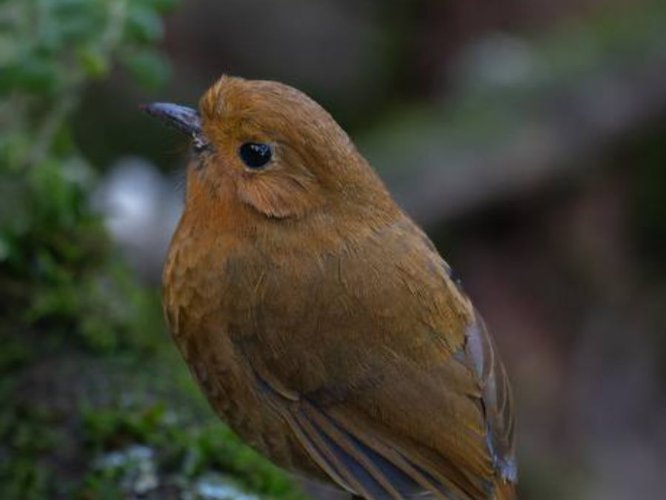
Equatorial Antpitta: the star of the forest
| Profile | Detail |
| Spanish name | Antpitta ecuatorial |
| Scientific name | Grallaria saturata |
| Size | About 14.5–15 cm |
| Habitat | Floor and understorey of humid montane forest rich in moss and epiphytes |
| Where to see it | Antpitta feeder, with a guide |
| Season | Resident, year-round |
The Equatorial Antpitta has an interesting backstory. For decades it was treated as part of the Rufous Antpitta complex (Grallaria rufula). In 2020, genetic and vocal studies (Isler et al., Zootaxa) raised it to full species. For many birders that means one thing: a new tick.
It’s a round, rufous-cinnamon ground bird that is usually heard far more than seen. At the feeder, with silence and patience, it comes within a few metres.
Photo tip: settle into the hide before it appears and stay still. Understorey light is low, so raise your ISO before the bird arrives, not once it’s there. Grey-breasted Mountain-Toucan: colour in the mist
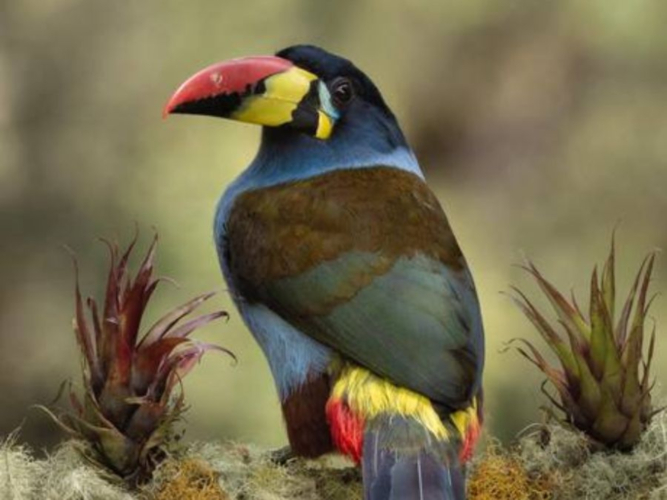
Grey-breasted Mountain-Toucan: colour in the mist
| Profile | Detail |
| Spanish name | Tucán de montaña pechigrís |
| Scientific name | Andigena hypoglauca |
| Size | 41–48 cm |
| Usual elevation | Mostly 2,200–3,650 m |
| Diet | Mainly fruit and berries |
| Season | Resident, year-round |
If one bird ends up as the cover shot, it’s this one: blue-grey breast, multicoloured bill, pale skin around the eye and a bright yellow rump. It lives only in the Andes of Colombia, Ecuador and Peru.
At the hacienda it has its own feeder, which turns a species that elsewhere can take hours of hiking into a very likely sighting. The IUCN currently lists it as Least Concern, after classing it as Near Threatened in 2016.
Photo tip: look for a clean background. The surrounding bromeliads and moss make a perfect frame.
Crescent-faced Antpitta: small and elusive
| Profile | Detail |
| Spanish name | Tororoí medialuna / Antpitta medialuna |
| Scientific name | Grallaricula lineifrons |
| Why it’s special | A sought-after high-Andean species that is hard to find across most of its range |
| Season | Resident, year-round |
Much smaller than the Equatorial, with a white crescent on the face that gives it its name. It’s the kind of species birders reroute entire trips for. At Hacienda El Bosque it is listed among the site’s highlight birds, with an antpitta feeder.
Photo tip: it moves fast through the vegetation. Use burst mode and continuous autofocus.
High-Andean hummingbirds
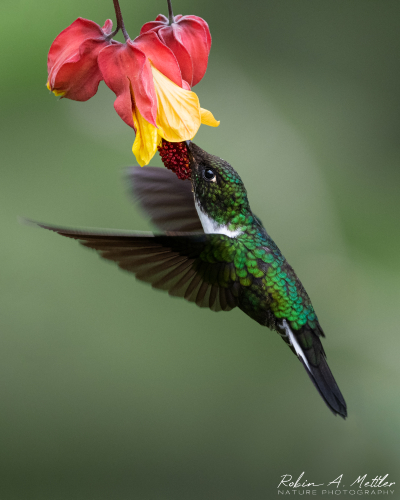
Sword-billed Hummingbird (Ensifera ensifera)
The only bird whose bill is longer than its body (excluding the tail). Watching one up close at a feeder is one of those scenes that turns people into birders. Resident year-round.
Purple-backed Thornbill (Ramphomicron microrhynchum)
The opposite extreme: a tiny bill and a back that flashes purple in the light. One of the site’s highlight species.
Tourmaline Sunangel (Heliangelus exortis)
A hummingbird with an iridescent throat that changes colour with the angle. Great for practising hummingbird photography.
Photo tip: with hummingbirds, shutter speed decides everything. Go fast to freeze the wings, or slower to show motion and accept some blur.
Other species worth adding to your list
- Barred Fruiteater (Pipreola arcuata): green with a barred breast and red bill. Very photogenic and calmer than it looks.
- Yellow-bellied Chat-Tyrant (Ochthoeca diadema): a small flycatcher with a yellow brow, typical of forest edges.
Seasons: when to see the birds of Hacienda El Bosque
All the species above are residents, present year-round. What changes with the season is the weather and the arrival of migrants.
| If you’re after… | Best time |
| The resident species in these profiles | Year-round, always at dawn |
| Better light and drier trails | Drier months (roughly Dec–Feb and Jun–Aug) |
| Migratory species | Roughly October to March (Caldas has 77 migratory species) |
| Combining with an event | Manizales Bird Fair, November 12–15, 2026 |
Time of day matters more than the month. The first hours of the morning bring the most activity at the feeders and on the trails.
Frequently asked questions about target birds near Manizales
How many bird species have been recorded at Hacienda El Bosque?
According to La FM and Semana (October 2026), about 170 bird species have been recorded at Hacienda El Bosque.
Where can I see the Equatorial Antpitta in Colombia?
It lives in the Andes of Colombia, Ecuador and Peru, mostly between 2,500 and 3,300 m. One place to see it up close is the antpitta feeder at Hacienda El Bosque, near Manizales.
Can I see the Grey-breasted Mountain-Toucan near Manizales?
Yes. It is regularly seen at Hacienda El Bosque, which has a feeder for the species. It is resident year-round.
Do I need a guide?
It isn’t mandatory, but it’s strongly recommended. Local guides such as Eddison and Néstor Zapata know each species’ calls and timing.
What’s the best time of day for birding at the hacienda?
Dawn. The first hours of the day bring peak activity at the feeders and on the trails.
Build your target list with us
Already have your target list? Send it to us on WhatsApp at +57 321 8116189 with your dates. We’ll tell you which species are most likely, arrange your guide and book you a cabin close to the feeders. We speak English, Spanish and French.